Synthetic Quantum Systems

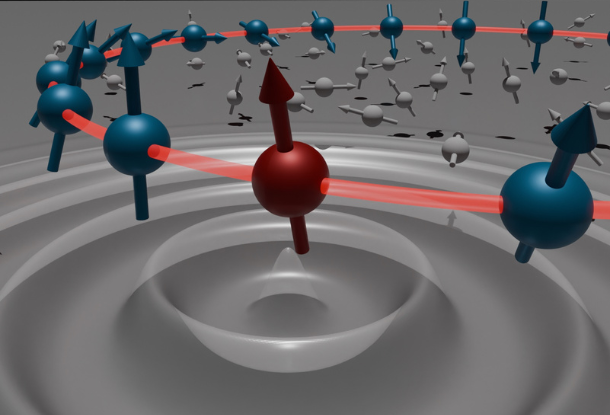
Large-scale quantum systems with tailored and tunable properties provide platforms for exploring emerging many-body quantum physics. 

Synthetic quantum systems, formed from interacting quantum gases, interacting spins or quasiparticle excitations in solids, have recently achieved the degree of tunability in dimensionality, local disorder potential and interaction type which is required for reaching unexplored regimes of complex quantum systems.

These recent technical advances are now also allowing for the development of large-scale quantum simulators and quantum sensor technologies with applications from life sciences over quantum chemistry and materials development to cosmology. 

Our work aims to maximize the bottom-up approach of building and controlling complex synthetic quantum systems through:

  • Designing interactions, geometry, disorder and topology;
  • full dynamical control over all Hamiltonian parameters and dissipation;
  • local manipulation and probing in addition to global controls;
  • real-time studies of far-from-equilibrium dynamics.

Our scientific goals include:

  • quantum simulation of Emergent Quantum Phenomena in materials and other fields (particles, cosmology);
  • discovery of new physics;
  • applications in sensing, quantum computation and communication.

Research areas

Bulk atomic gases

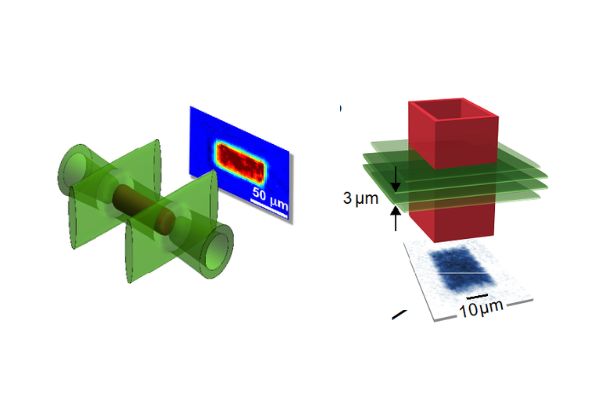
We explore matter at nanokelvin temperatures where quantum statistics dominate. Using “optical box” traps, we create uniform quantum fluids to measure phase transitions and scaling laws precisely, free from the density fluctuations of traditional traps.

These platforms facilitate the study of quantum turbulence and the transition between three-dimensional and two-dimensional physics. By observing energy cascades through these superfluids, we gain insights into many-body systems far from equilibrium.

These experiments serve as pristine environments for discovering universal properties of matter that transcend specific atomic species and remain hidden in complex materials.
Atoms in Optical Lattices

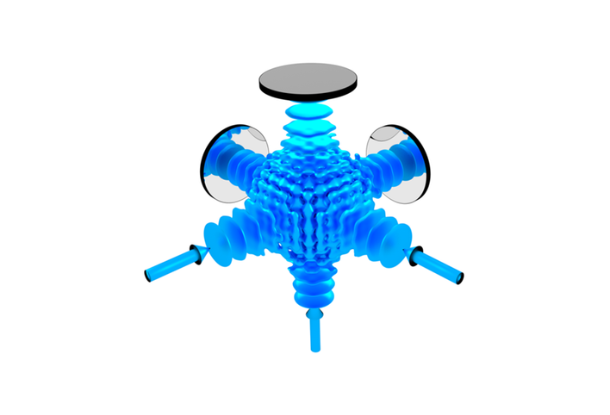
We use counter-propagating lasers to create periodic “crystals of light,” simulating electron behavior in solid-state materials. These optical lattices act as programmable quantum simulators for studying complex phenomena like high-temperature superconductivity.

Key investigations include many-body localisation, where disorder prevents thermalization to preserve quantum information, and Floquet engineering, which uses periodic driving to synthesise new states of matter. These experiments provide a bridge between quantum optics and materials science, addressing problems that are computationally impossible for classical supercomputers while exploring the collective dynamics of interacting particles.
Solid-State Spins and Photons

We create and use nanoscale materials which permit the manipulation of electronic and nuclear-spin qubits within wide-bandgap (for example diamond) or semiconducting crystals. A primary goal is developing high-quality interfaces between these stationary spin qubits and light as single photons, enabling future quantum networks and efficient sensors.

Using nitrogen-vacancy centers in diamond, we have pioneered nanoscale sensors for magnetic resonance imaging at the single-molecule level. Furthermore, leveraging ensembles of nuclear spins as robust quantum memory protects information from decoherence.

These solid-state platforms integrate light-matter interactions with scalable photonic and electronic manufacturing, offering a viable path toward practical quantum technology, high-speed communication, and ultra-precise biological sensing.

Researchers and Research Groups associated with this theme

Dr Helena Knowles

Royal Society University Research Fellow

Dr Dorian Gangloff

Royal Society University Research Fellow

Prof Nigel Cooper

Deputy Head of Department for Research Strategy, and Professor of Theoretical Physics

Prof Zoran Hadzibabic

Professor or Physics

Prof Ulrich Schneider

Professor of Many-Body Physics

Related News

Connect with us

News

Polarisation of blue laser light being adjusted before cooling atoms to near absolute zero. Credit: Dr Thomas Walker. © Imperial College London.

Cancelling laser noise in atomic quantum sensors 

Results from a UK collaboration overcome major obstacle towards building large-scale atom interferometers.    A prototype quantum sensor developed by the Atom Interferometer Observatory and Network (AION) consortium has demonstrated, for the first time, that a...

19 June 2026

News

repeated geometrical pattern

Resonances create energy gaps in quasicrystals: a long-sought analytical breakthrough

New analytical work by Cavendish Laboratory researchers shows how true energy gaps can arise in quasicrystals, answering a longstanding open question about these extraordinary materials.   Quasicrystals sit between ordinary crystals and fully disordered materials: their atoms...

1 May 2026

News

New applied quantum initiative to advance research translation at Cambridge

Quantum technology research at the Cavendish Laboratory will benefit from a new collaboration with FormationQ, an independent platform for quantum adoption and application, to help speed translation of the University...

3 February 2026

News

Ultracold atoms reveal universal rules far from equilibrium

Recent research has revealed that a two-dimensional homogeneous Bose gas, once driven far from equilibrium, displays universal behaviour independent of its starting conditions. This discovery offers new insights into how...

30 September 2025

News

AI generated image

Quasiperiodic materials enable robust quantum transport without energy gaps

A new study has overturned conventional wisdom in the world of quantum mechanics, showing that quantum particles can be shuttled across a system in a perfectly precise way, even in...

11 July 2025