Prof Jeremy Coles
Research Professor
Biography
Jeremy graduated in Physics from the University of Oxford and then studied for an MSc. in astrophysics in the mathematics department of QMUL, University of London where his thesis explored higher-dimensional cosmological models. From there he moved on to a PhD (London/CERN) that explored R-parity violations in supersymmetry. After several years working in London based IT (systems architecture and software development) and management consultancy he took up a role first at the Rutherford Appleton Laboratory (RAL), UK, and then the University of Cambridge, under a UK Particle Physics Grid (GridPP) grant, to help develop the European Grid for eSciencE (which became the European Grid Initiative) and the Worldwide Large Hadron Collider Computing Grid (WLCG) which enabled physicists to announce the discovery of the Higgs Boson in 2012.
In 2014 Jeremy shifted focus to support the development of the Square Kilometer Array (SKA) radio telescope. Initially this was as a coordinator of activities within the pre-construction Science Data Processor (SDP) design consortium and as a member of the project leadership group. During a bridging phase to construction he oversaw a team working on telescope simulation and modeling in support of the SKA telescope system critical design review, and then became the first Release Train Engineer for the SDP construction teams. Since 2021/2022, when SKA Regional Centre (SRC) work began in earnest, he has taken on various roles supporting the development and implementation of the SRC Network and is one of the founding members, and current deputy director, of the UK SKA Regional Centre (ukSRC).
Research
Jeremy is a co-investigator on several UK SKA grants. He has a broad set of physics research and computational engineering interests spanning:
- Distributed computing and data intensive science approaches;
- Radio astronomy methods and computational implementations;
- Particle astrophysics and cosmological modelling.
As one of the initial members of Cambridge Big Data and as a steering committee member of the Cambridge Centre for Data-Driven Discovery:
- Analysis, understanding and use of data science and AI.

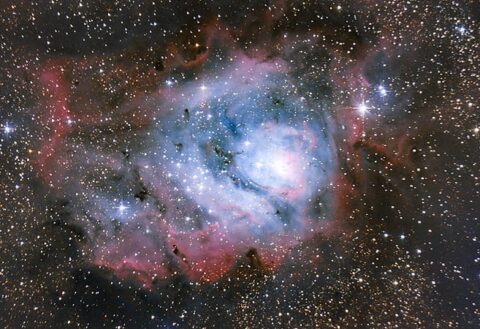
This theme focuses on observational studies of the unexplored Universe; from its very first moments, through the mysterious early epochs when the Cosmos became the complex realm of celestial objects we know it to be.