Scientists confirm a new type of magnetism deep inside a material
26 August 2026
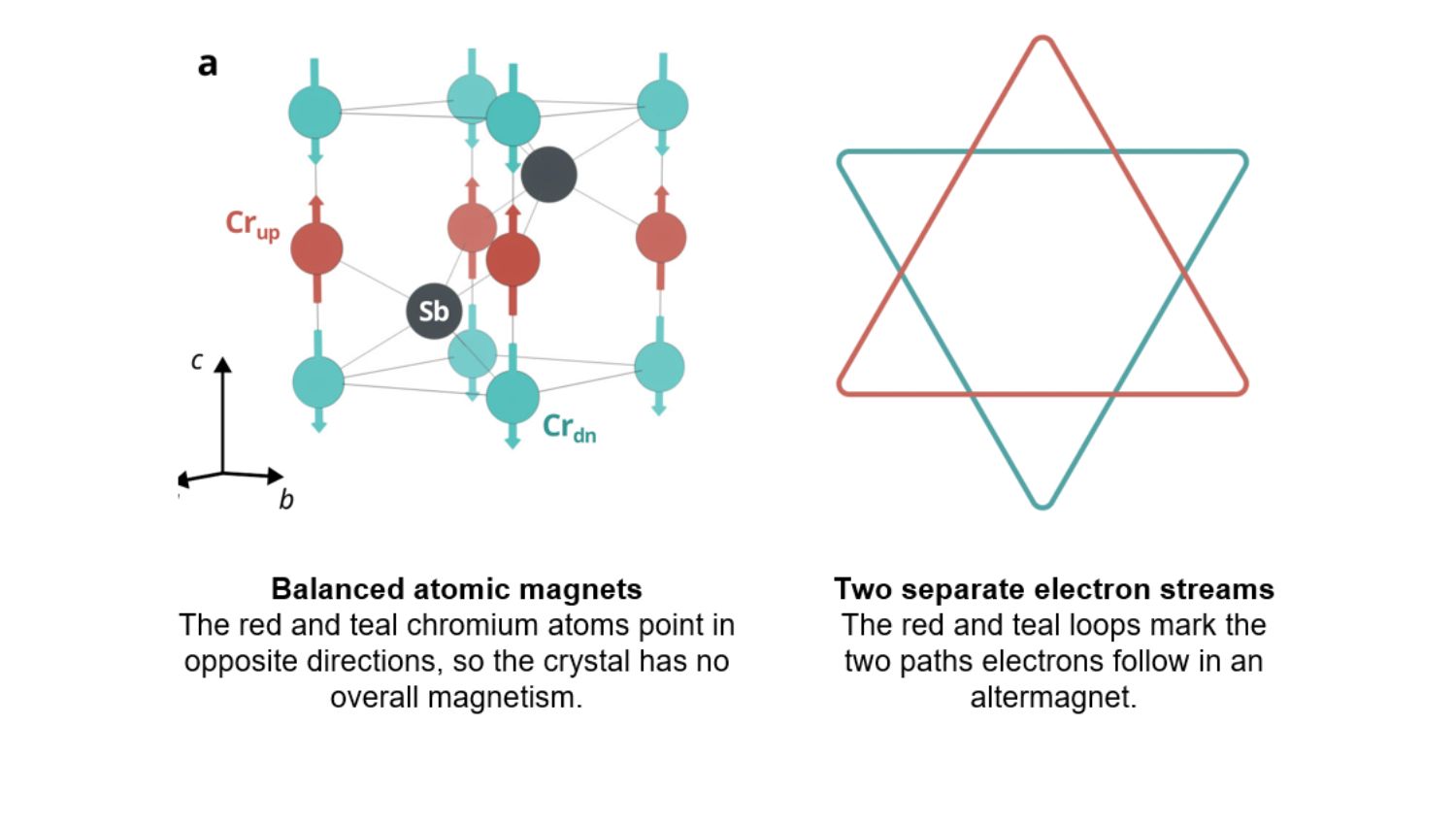
Magnetism comes from electrons, which act like tiny magnets inside materials. How these tiny magnets are arranged determines how a material behaves. In familiar magnets such as iron, many point in the same direction, creating a magnetic field. In yet another type, known as an antiferromagnet, neighbouring magnets point in opposite directions and largely cancel each other out.
Scientists have recently identified another form of magnetism, called ‘altermagnetism’, which combines features of both of the above magnetic states while remaining distinct from either.
Now, in their paper published in Nature, the researchers have confirmed altermagnetism deep within a material called chromium antimonide (CrSb) for the first time.
“By using a technique that tracks how electrons move deep inside the crystal under extremely strong externally applied magnetic fields, we found that spin-up electrons and spin-down electrons with the same momentum have different energies. Because of this, the closed paths electrons describe when moving in strong magnetic fields are different for spin-up and spin-down electrons. However, for some magnetic field directions they are mirror versions of each other and therefore enclose the same area, whereas for other field directions, they do not. Our measurements resolved this cross-sectional area and its splitting, when the field direction is changed,” said Mengmeng Long, joint-lead author of the study and PhD student in the Quantum Matter group.
“By systematically changing this direction and measuring the response, we were able to reconstruct the magnetic behaviour throughout three-dimensional space. The resulting pattern looked like a six-petalled flower – the same shape as a ‘g-orbital’ of a hydrogen atom.”
This directional pattern is a defining signature of the unconventional magnetic order predicted for CrSb and allowed the researchers to directly confirm altermagnetism within the bulk of the material.
Through this research, the scientists also wanted to establish whether the unusual magnetic behaviour proposed for CrSb is an intrinsic property of the material itself or just confined to its surface.
This distinction matters a lot because previous evidence for altermagnetism in other materials came from surface-sensitive techniques. In at least one prominent case, this later turned out to be misleading – the surface looked to be behaving altermagnetically while the bulk material underneath wasn’t.
“To determine what was happening inside CrSb, we used a technique that directly probed how electrons behave deep within the crystal. This allowed us to unambiguously confirm bulk altermagnetism in the material for the first time, rather than only detecting signs of it at the surface,” added Dr Theo Weinberger, joint lead-author of the study, Henslow Fellow in Physics at Murray Edwards College and Affiliated Member of the Quantum Matter group.
“On top of that, we have produced a detailed full 3D map of an unconventional ‘order parameter’ – essentially the precise mathematical pattern describing how the magnetism varies with direction inside the material – something that’s normally extremely difficult to pin down, even in other, better-studied areas of physics like unconventional superconductivity.”
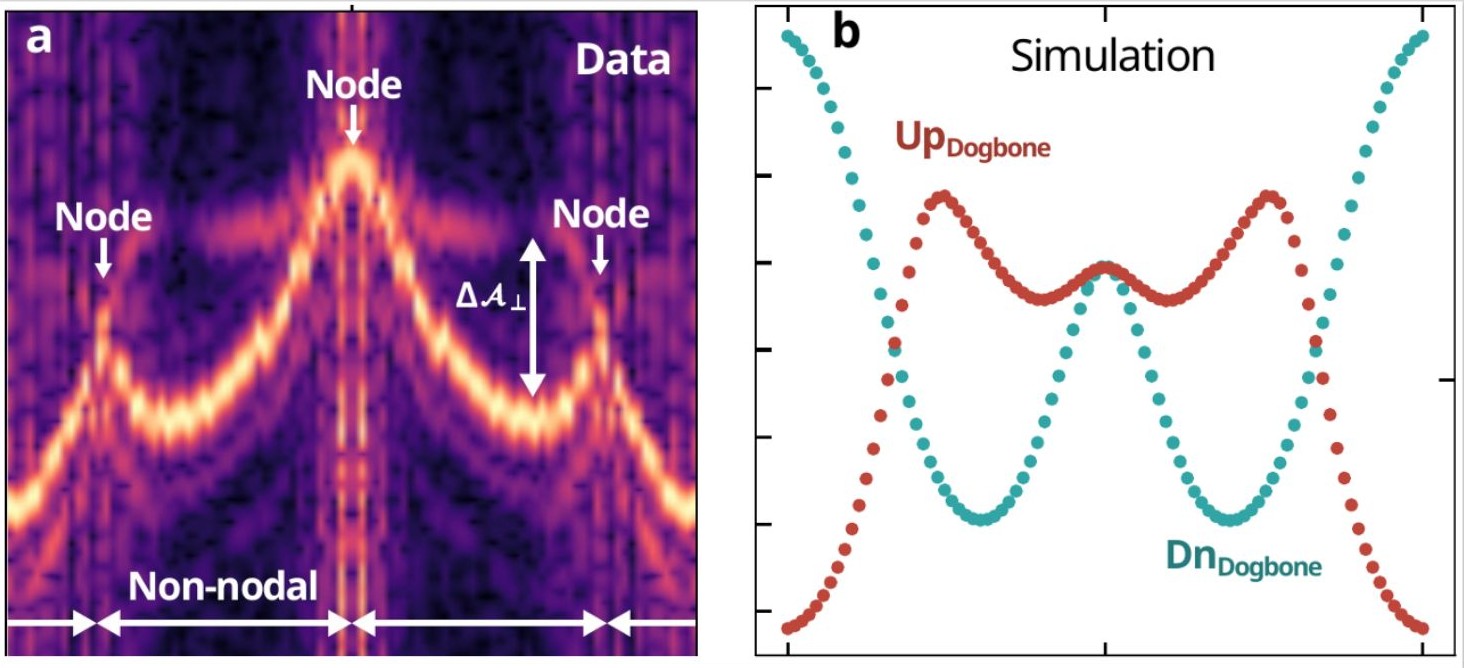
Illustration of measured quantum-oscillation frequencies (left) match the predicted spin-up and spin-down branches. (right) The branches join at symmetry-protected nodes and separate elsewhere – the bulk fingerprint of g-wave order.
These findings could also have implications for future electronics. Altermagnets combine useful characteristics normally associated separately with ferromagnets and antiferromagnets. This makes them exciting for building faster, smaller, more energy-efficient computer memory and data storage. CrSb is especially promising because it orders above room temperature, is made from cheap and abundant elements, and can be grown as high-quality, stable crystals. By giving the first solid, bulk-confirmed proof that altermagnetism exists in a real material – and the first detailed 3D picture of exactly how it behaves – this work puts altermagnetism on a firm empirical footing.
Researchers can now investigate how this unusual magnetic state can be controlled and whether its properties can ultimately be harnessed in future electronic technologies.
Image:
Image: Illustration of g-wave altermagnetic order parameter | Credit: Dr Theo Weinberger
Reference:
Mengmeng Long, Theodore I. Weinberger, Zheyu Wu, Mads F. Hansen, Ran Tao, Mridul Shrestha, Dave Graf, Yurii Skourski, F. Malte Grosche, Alexander G. Eaton, ‘3D bulk-resolved ?-wave altermagnetic order parameter in CrSb’, Nature (2026). DOI: 10.1038/s41586-026-10902-z

The text in this work is licensed under a Creative Commons Attribution-NonCommercial-ShareAlike 4.0 International License. Images, including our videos, are Copyright ©University of Cambridge and licensors/contributors as identified. All rights reserved. We make our image and video content available in a number of ways – on our main website under its Terms and conditions, and on a range of channels including social media that permit your use and sharing of our content under their respective Terms.