New insights into sodium-ion cathode material could help improve battery lifetime for large-scale energy storage
20 May 2026
Researchers have uncovered new details about how a promising sodium-ion battery material changes while charging, offering a potential route to longer-lasting batteries for storing renewable energy.
“Whilst there isn’t any one battery technology to rule them all, sodium-ion batteries have so much potential to be cheaper and more sustainable […]”
Dr James Steele
The work, carried out in collaboration between the Cavendish Laboratory and Yusuf Hamied Department of Chemistry focuses on sodium nickelate (NaNiO2), the parent material for a type of “nickel-rich” cathodes that can store more energy than materials using other metals, but which breaks down quickly because of ordering phenomena. By gaining a better understanding of the structures that form in the most nickel-rich possible sodium-ion cathode material, the researchers hope to design cathodes that do not degrade as quickly. The study has been published in the Journal of the American Chemistry Society (JACS).
Sodium-ion batteries are being explored as a cheaper, more sustainable alternative to lithium-ion ones, which are commonly used in everyday objects such as laptops or phones. The materials used in lithium-ion batteries are considered critical because demand is high and they are becoming more expensive and harder to source. Sodium, by contrast, is far more abundant, can be sourced all over the world and costs a fraction of the price, making it an attractive option for large-scale energy storage.
“Not a lot is known about the crystal structures present in many sodium-ion cathodes, and lessons from lithium-ion batteries do not always carry across,” said Dr James Steele, who led this research as a NanoDTC PhD student at the Cavendish Laboratory. “Because sodium-ions are bigger, they repel each other more strongly and tend to arrange themselves in special patterns, or “superstructures”, in a phenomena we call sodium-ion vacancy-ordering.”
Nickel ions exist in different charge states, also arranging themselves through “charge-ordering”. Counterintuitively, ordering is usually bad for battery stability: when a material has lots of stable, ordered structures, continuously changing between them can accelerate degradation. Understanding what these structures are, and how they are stabilised, could help researchers design longer-lasting batteries through dopants or improved processing techniques.
For this study, the team identified the structures of the phases that form as sodium is electrochemically removed from sodium nickelate. To investigate how the cathode, or positive electrode, changes as sodium moves in and out during charging and discharging, the researchers used x-rays and neutrons in diffraction experiments to work out the crystal structures of the material and to see how those structures changed while the battery was charging. These phases show special arrangements of sodium-ions and different nickel oxidation states that result in stable structures. The live, in operando measurements also allowed the team to track how the structure evolves in real time and to identify additional “metastable” phases: unstable states that can’t be found by standard diffraction measurements, which are usually taken after a cell is charged and disassembled (giving it time to relax into stable structures).
“Whilst there isn’t any one battery technology to rule them all, sodium-ion batteries have so much potential to be cheaper and more sustainable, making grid-scale electrochemical energy storage more practical and feasible,” said Steele, now a Postdoctoral Researcher at the University of Oxford. “Our work represents one small step in the direction of developing sodium-ion cathode materials which meet these key metrics.”
One of the more surprising findings was that order and stability are not always helpful in battery materials. “Because batteries rely on change, too many stable structures can create mismatches in material properties, leading to stress, strain and cracking in the cathode particles,” said Prof Sian Dutton, from the Cavendish Laboratory. “In sodium-ion batteries these effects are more pronounced because sodium is larger. This degradation leaves parts of the material electrochemically inactive and reduces battery performance.”
The next step is to use these findings to design and synthesise new materials with improved performance. “One direction the research community is investigating is placing larger, higher-charge ions in the sodium layer as structural “pillars”, helping to prevent the layers from changing too much when sodium is removed,” said Steele. “For us, it’s now about exploring target compositions using small amounts of dopant elements to influence the ordering phenomena observed in the study.”
The Cambridge team is also continuing to work with national facilities to learn more about how sodium-ions move in cathodes, using muon spin-resonance spectroscopy alongside in-house solid-state nuclear magnetic resonance facilities at the Department of Chemistry. This could also help them understand how to make sodium-ion batteries charge faster to store large amounts of renewable energy, “so that we can keep the lights on whatever the weather.” concluded Steele.
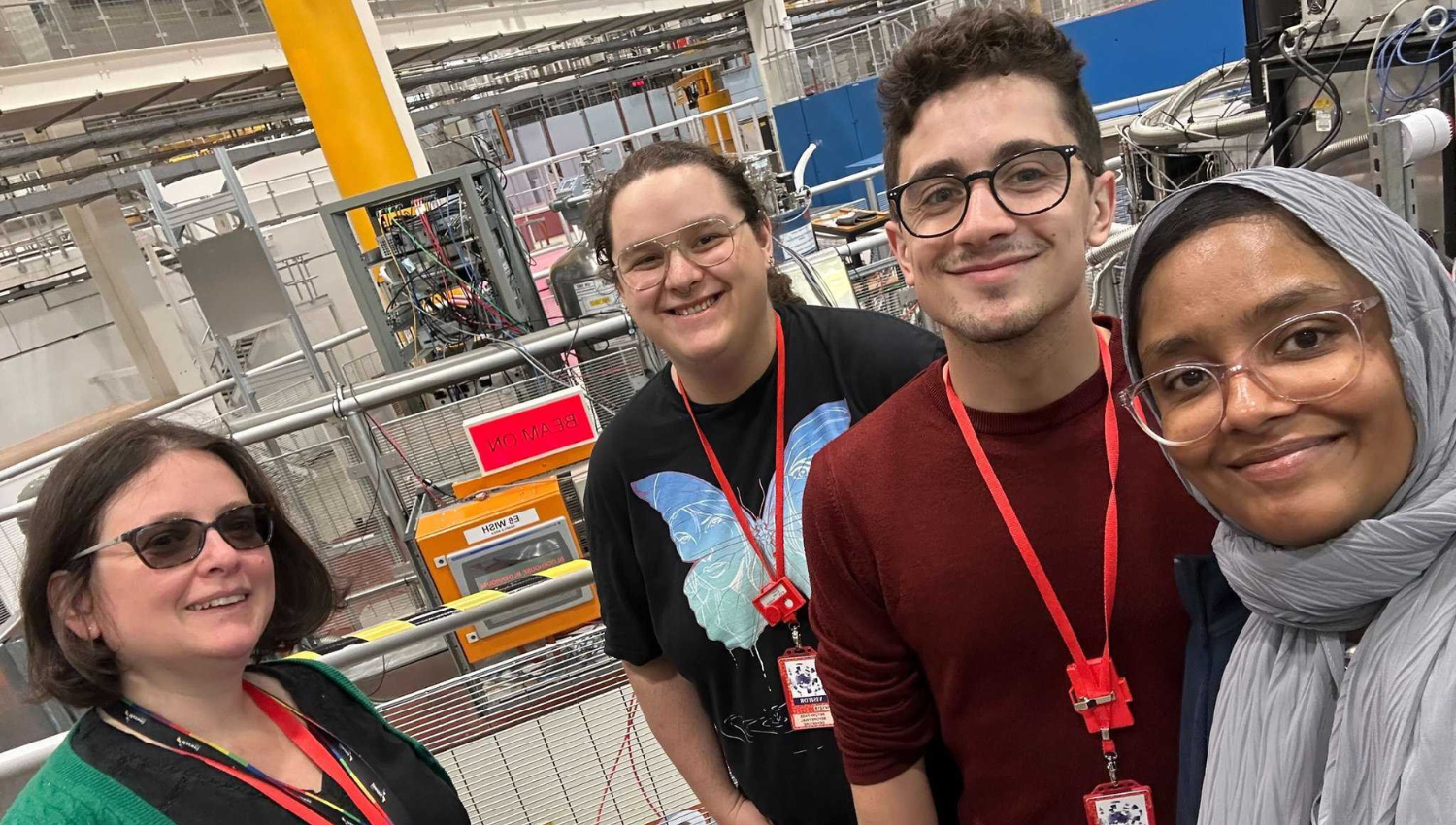
The experimental team used the WISH neutron diffractometer at ISIS Neutron and Muon Source to solve the structures which form when sodium nickelate is charged. Left to right: Prof Siân Dutton, Dr James Steele, Dr Liam Nagle-Cocco and Dr Farheen Sayed
Reference:
James M. A. Steele et al., ‘Evolution of Charge and Orbital Ordering, and Cation Vacancy Ordering During Electrochemical Desodiation of NaxNiO2‘, J. Am. Chem. Soc. 2026, DOI: 10.1021/jacs.6c03074
Contributors to this research:
- Experimental team: Dr James M.A. Steele, Prof Joshua D. Bocarsly, Dr Liam A. V. Nagle-Cocco, George S. Phillips, Dr Farheen N. Sayed, Dr Giulio I. Lampronti, Prof Dame. Clare P. Grey, Prof Siân E. Dutton
- Diamond Light Source Beamline Scientists: Dr Iuliia Mikulska, Dr Eamonn Connolly, Dr Sarah Day, Dr Lucy Saunders
- ISIS Neutron and Muon Source Instrument Scientists: Dr Fabio Orlandi, Dr Pascal Manuel
Banner image:
Batteries are charged whilst x-ray diffraction patterns are measured using detectors at the I-11 High-resolution powder diffraction beamline at Diamond Light Source, the UK’s national synchrotron science facility.

The text in this work is licensed under a Creative Commons Attribution-NonCommercial-ShareAlike 4.0 International License. Images, including our videos, are Copyright ©University of Cambridge and licensors/contributors as identified. All rights reserved. We make our image and video content available in a number of ways – on our main website under its Terms and conditions, and on a range of channels including social media that permit your use and sharing of our content under their respective Terms.