A quantum ‘phase-space’ microscope could see both where atoms are and how they move
21 October 2026
Physicists have proposed a way for quantum gas microscopes, which photograph individual atoms in ultracold atomic gases, to capture how each atom is moving as well as where it is. The scheme opens a new experimental window on how particles move and correlate in quantum many-particle systems, and could reveal physics that has so far been hidden from view.
“We are now exploring how this phase-space microscope could reveal entanglement and the intricate dance of particles in strongly correlated quantum matter. We hope experimentalists will take it up — and find things we haven’t yet thought to look for.”
Professor Nigel Cooper
Since they were first demonstrated in 2009, quantum gas microscopes have transformed the study of quantum matter. By cooling clouds of atoms to within a whisker of absolute zero, introducing strong interparticle interactions, and then photographing them, physicists can take snapshots of complex quantum states in which the position of every atom can be separately resolved.
But these snapshots tell only half the story. They reveal where each atom is, but not how it is moving: they see only one axis of ‘phase space’, the map of both position and momentum. That missing information matters: the flow of particles, the local temperature, and the swirling vortices of quantum fluids all depend on motion rather than position.
Now, researchers at the Cavendish Laboratory, University of Cambridge, and TU Dortmund University have shown how this gap could be filled. Their proposal, published in Physical Review Letters, describes how existing experiments could be adapted to record each atom’s momentum alongside its position, in a single shot.
“Quantum gas microscopes have given us extraordinary pictures of quantum matter, but they are still pictures of where the atoms are,” said Prof Dr Christof Weitenberg, from Technische Universität Dortmund. “So much of the physics we care about — transport, heat flow, quantum zero-point energy — is about how things move locally. We wanted to find a way to see that directly.”
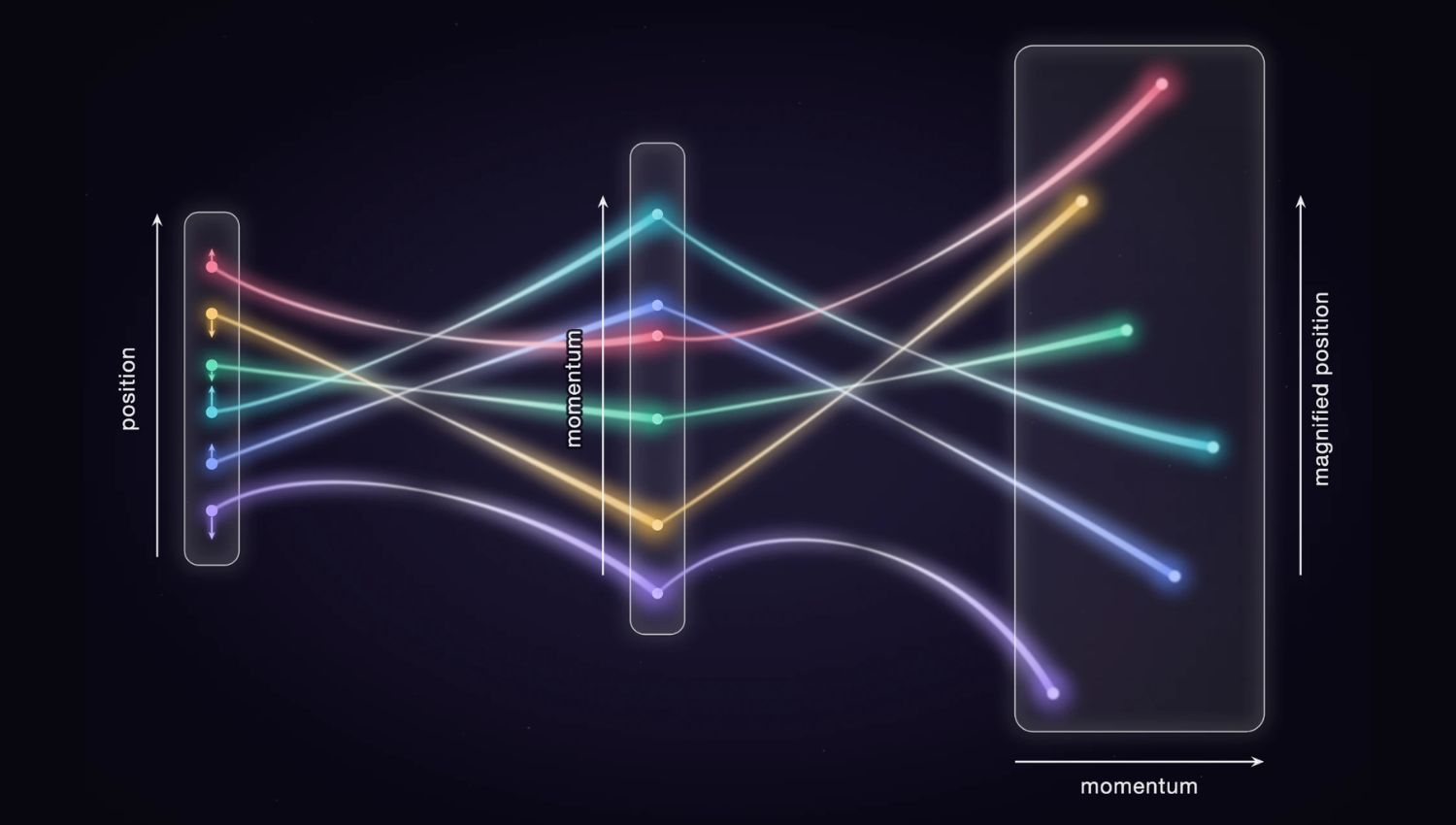
An artistic impression of the proposed scheme. Atoms in an initial state (left-hand panel) pass through a first matter-wave lens, which sorts them by their momentum (central panel). This information is written into an additional degree of freedom; measuring it together with position after the second lens gives a final image that records a snapshot in phase space (right-hand panel). Credit: Nigel Cooper.
An idea from classical optics
The scheme takes inspiration from the phase-contrast microscope, invented by Frits Zernike, who received the 1953 Nobel Prize in Physics for it. Many biological samples are almost transparent: they barely change the brightness of light passing through them, only its phase, which the eye cannot see. Zernike realised that between the two lenses of a microscope lies a special place, the “Fourier plane”, where light is sorted by spatial frequency. By placing a small phase plate there, he could turn invisible phase shifts into visible contrast — allowing living cells to be studied in detail without staining or killing them. This shows that actions on the Fourier plane can reveal information that an ordinary image hides.
The new proposal applies the same geometry to atoms. It builds on the quantum gas magnifier, an instrument developed by co-author Christof Weitenberg and colleagues, which uses two “matter-wave lenses” — achieved in practice by letting the atoms oscillate in a smooth trap for precisely timed intervals — to magnify a cloud of atoms before it is imaged. During these lensing steps the interactions between the atoms are switched off, so each atom travels independently and the lenses act on every atom in the same way. Between these lenses lies a Fourier plane, where the atoms are sorted by momentum.
Similar to the phase-contrast microscope, this quantum gas magnifier also allows manipulation in the Fourier plane of the matter-wave optics. But instead of a phase plate, the researchers propose encoding information about each atom’s momentum in an additional degree of freedom – another property of the atom, separate from its position, such as its out-of-plane momentum, or its internal spin. In the final image, an atom’s location gives its initial position, and measuring this extra degree of freedom also gives its initial momentum, allowing its position in phase space to be imaged.
“The Fourier plane is where the momentum information is laid out in space,” said Yuchen Yang, PhD student at the Cavendish Laboratory. “The trick is to write that information into some new co-ordinate before the second lens puts everything back together. Then one photograph tells you both where each atom is and how it was moving.”
What about Heisenberg?
At first sight, this might seem to break one of the most famous rules in physics. Heisenberg’s uncertainty principle says that the position and momentum of a particle cannot both be known exactly.
However, theorists have long known that position and momentum can be measured together, provided neither is measured sharply. In a classic 1965 paper, Arthurs and Kelly showed how such a joint measurement of incompatible observables could work in principle, and worked out the minimum amount of uncertainty it must carry.
The new scheme carries out exactly this kind of joint measurement, as a generalised quantum measurement — known to physicists as a positive operator-valued measure — made possible by the additional degree of freedom. Remarkably, the team’s analysis shows that it is optimal: it can reach the minimum joint uncertainty identified by Arthurs and Kelly.
Towards a new view of quantum matter
Because the scheme uses techniques already available in cold-atom laboratories, the researchers believe it could be implemented in existing experiments. Once built, it would allow quantum gas microscopes to map velocities as well as positions, atom by atom across large gases.
That would open a direct view of phenomena that are currently hard to access: how particles and heat flow through strongly correlated quantum materials, how vortices form and move in superfluids, and how quantum systems evolve when driven far from equilibrium.
“Joint measurements of position and momentum have been a textbook idea for decades. What is exciting is that a small adaptation of existing quantum gas magnifiers can implement them — even optimally,” said Prof Nigel Cooper, Professor of Theoretical Physics at the Cavendish Laboratory. “We are now exploring how this phase-space microscope could reveal entanglement and the intricate dance of particles in strongly correlated quantum matter. We hope experimentalists will take it up — and find things we haven’t yet thought to look for.”
The research was supported by the Engineering and Physical Sciences Research Council (EPSRC), the Simons Foundation, the Cambridge Trust, and by the Deutsche Forschungsgemeinschaft (DFG, German Research Foundation).
Reference:
Nigel R. Cooper, Yuchen Yang and Christof Weitenberg, ‘Phase-space microscopes for quantum gases: Imaging conjugate variables and momentum-weighted densities.’ Physical Review Letters (2026). DOI: 10.1103/12rn-rlg8.

The text in this work is licensed under a Creative Commons Attribution-NonCommercial-ShareAlike 4.0 International License. Images, including our videos, are Copyright ©University of Cambridge and licensors/contributors as identified. All rights reserved. We make our image and video content available in a number of ways – on our main website under its Terms and conditions, and on a range of channels including social media that permit your use and sharing of our content under their respective Terms.