First funded research projects announced as IonQ Quantum Innovation Centre opens in Cambridge
15 October 2026
The opening of the IonQ Quantum Innovation Centre marks the next phase of the University of Cambridge’s corporate research partnership with IonQ, and strengthens Cambridge and the UK’s position at the forefront of quantum research.
Nine research projects have been awarded through the Centre’s inaugural first funding call, spanning a broad range of disciplines and potential applications in quantum computing, networking, sensing, and security.
Drawing on Cambridge’s Departments of Physics, Engineering, and Computer Science and Technology, the Milner Therapeutics Institute, and Cambridge Judge Business School, they reflect the depth and breadth of expertise across Cambridge and will support advances in quantum science, engineering and their applications.
The IonQ Quantum Innovation Centre was established through a 10-year strategic partnership between the University of Cambridge and quantum technology company IonQ. The partnership aims to accelerate research and discovery across quantum science, engineering and related applications in the UK. The Centre provides significant funding for investigator-led blue-skies and translational research across quantum technologies and will host a state-of-the-art 256-qubit IonQ quantum computer, due to be deployed at the University of Cambridge by summer 2027.
“The opening of the IonQ Quantum Innovation Centre turns a landmark agreement into a working home for quantum research inside one of the world’s most storied physics laboratories,” said Niccolo de Masi, Chairman and CEO of IonQ. “By bringing quantum computing, networking, sensing, and security research together at Cambridge, we are accelerating the timeline between academic discovery and commercial quantum advantage. This is a long-term commitment to the United Kingdom, built for researchers, start-ups, and industry alike.”
The Centre’s nine inaugural research projects will bring together Cambridge researchers and IonQ specialists to advance quantum hardware and explore new applications across science and industry. Selected by a Joint Steering Committee comprising business and scientific leaders from both organizations, the projects combine Cambridge’s research expertise with IonQ’s capabilities in trapped-ion quantum computing, quantum networking, and device engineering.
Across the projects, students and postdoctoral researchers will gain experience connecting fundamental research with technology development and applications, helping train the next generation of leaders in quantum science and engineering.
“The official launch of the IonQ Quantum Innovation Centre is an exciting milestone in our partnership with IonQ, which will help Cambridge and the UK stay at the forefront of the quantum revolution,” said Professor Mete Atatüre, Head of the Cavendish Laboratory. “The announcement of the first round of the funded research projects celebrates the depth and breadth of expertise and talent at Cambridge, and will accelerate our impact in quantum science and engineering.”
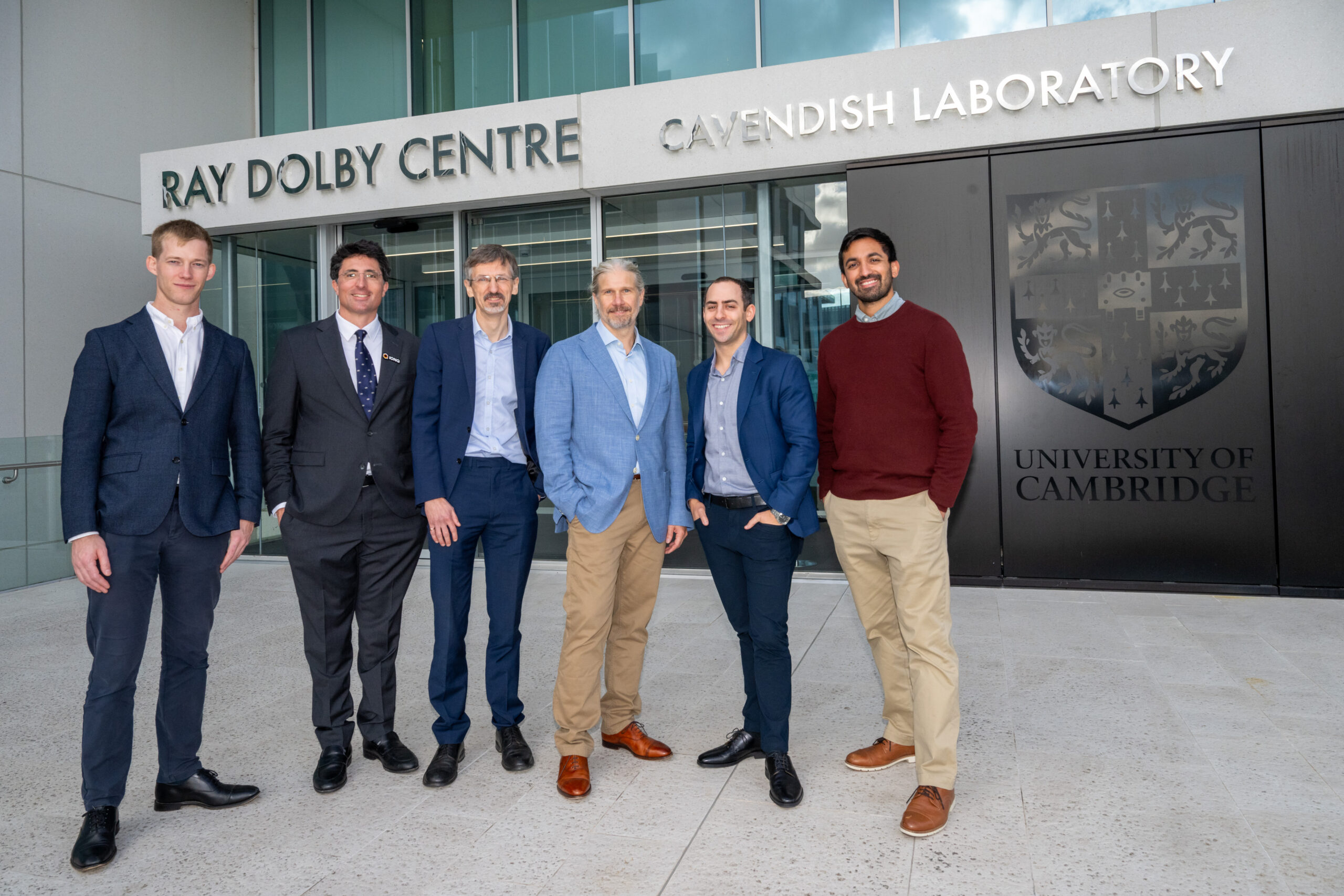
Left to right: Christopher Ballance, President, Quantum Computing, IonQ; Niccolo de Masi, IonQ’s Chairman and CEO; Prof Sir John Aston, Pro Vice-Chancellor for Research at the University of Cambidge; Mete Atatüre, Head of the Cavendish Laboratory; Jordan Shapiro, President and General Manager, Quantum Platform, IonQ; and Mihir Bhaskar, SVP & General Manager of Quantum Technologies, IonQ. Credit: Fiona Hanson.
The nine inaugural funded research projects are:
- Using quantum computers to simulate neutrinos and cosmic structure – Sandro Tacchella, Cavendish Laboratory
Massive neutrinos leave a subtle imprint on how dark matter assembles and galaxies form, but accurately simulating their behaviour is exceptionally demanding. This project will use the IonQ quantum computer to test a new way of modelling neutrinos in the Universe, helping to establish whether quantum computing could eventually improve predictions for major cosmological surveys such as DESI, Euclid and Roman.
- Building Error-corrected Fermionic Ion Trap Simulations – Prakash Murali, Department of Computer Science and Technology
Every new medicine, battery and catalyst comes down to how electrons behave inside a molecule. That behaviour is so intricate that even the world’s largest supercomputers can only approximate it. Although quantum computers could simulate these processes more directly, the computational cost remains too high, partly because different parts of the computing system are designed in isolation. This project treats them as one problem: how electrons are represented, how errors are caught and corrected, and how instructions reach real trapped-ion hardware. The aim is to bring useful simulations of chemistry within reach of the near-term fault-tolerant quantum computers.
- Portfolio Optimisation Using IonQ Quantum Computers – Crispin Barnes, Cavendish Laboratory
This project will explore whether quantum computers can help identify lower-risk approaches to spreading investments, a challenge faced by pension funds and other investors. The researchers will test the method on IonQ’s quantum computers using real financial data and compare it with conventional approaches to understand where quantum computing could offer a practical advantage.
- Hardware-native quantum walks on disease networks – Nahmshik Han, the Milner Therapeutics Institute
Finding the right protein to target is the first and most consequential decision in developing a new medicine. However, most needed proteins are often hidden deep inside vast networks of interacting molecules, where conventional computational methods lose sight of them. This project will use quantum walks, a quantum equivalent of the random-search that underpins much of today’s drug discovery, to reach these hidden proteins. Simulations have shown that the approach can uncover disease targets missed by classical methods. The researchers will now test it on IonQ’s trapped-ion systems, from its Quantum Cloud to the 256-qubit machine coming to Cambridge, with the aim of identifying new cancer drug targets for experimental validation by the end of the project.
- QUPROP: Beyond the curse of dimensionality in engineering dynamics – Fehmi Cirak, Department of Engineering
Engineering structures, from bridges and wind turbines to aircraft, face uncertain dynamic loads from earthquakes, strong winds and mechanical vibrations. Predicting how they will respond, and how likely they are to fail, especially under extreme conditions, can require vast amounts of computation. This project will explore whether new methods designed for quantum computers can make these calculations substantially faster, and will test them on IonQ systems.
- From Quantum Hardware to Scientific Capability: The Cambridge–IonQ Quantum Computer – Virginia Leavell, Cambridge Judge Business School
Emerging technologies like quantum computing are still unsettled. In this early, anticipatory period, their uses and form take shape through choices and experiments, making it especially important to study how they develop. The process is recursive: as researchers explore what a quantum computer can do, their work also shapes how the computer develops and how quantum computing evolves more broadly. To study this important early period, this project follows Cambridge researchers as they begin working with a new IonQ quantum computer, exploring how they make sense of the hardware, identify questions it might help answer, and learn from early experiments.
- Fully integrated diamond SnV PIC – Mete Atatüre, Cavendish Laboratory
Quantum networks are a key enabling technology for applications including distributed quantum computing, secure quantum communication, and networked sensing. Practical large-scale networks will require nodes containing hundreds to thousands of qubits, making it essential to increase the number of optically addressable qubits within each node. This proposal addresses the key challenges in scaling memory-based quantum network nodes by developing an integrated photonic architecture for tin-based optically active spin qubits in diamond.
- Deterministic fabrication of solid-state quantum memory arrays (TinAct) – Dorian Gangloff and Andreas Thurn, Cavendish Laboratory
Quantum technologies will rely on networks of quantum memories that can store and share quantum information. This project aims to overcome a major manufacturing challenge by using laser pulses to activate individual quantum memories inside diamond chips while monitoring their formation in real time. The approach could enable the creation of large arrays of quantum memories and improve the manufacturing yield of nanoscale interfaces between qubits and photons.
- Meta-mirror cavity arrays for trapped-ion cavity QED – Amit Agrawal, Electrical Engineering Division
Trapped-ion quantum computers store information in individual charged atoms, or ions, and read it out by collecting the light the ions emit. This project will develop flat mirrors, patterned at the nanoscale, that act like curved mirrors. Pairs of these mirrors form miniature optical cavities that capture more of each ion’s light and send it into an optical fibre. Because the mirrors are made with chip-manufacturing techniques, they can be built as arrays with one cavity per ion, supporting more efficient readout and the linking of quantum computers into networks.
Lead image:
Niccolo de Masi, Chairman and CEO of IonQ and Professor Sir Jon Aston, Pro Vice-Chancellor for Research at the University of Cambridge, unveil the sign in front of the IonQ Quantum Innovation Centre in the Ray Dolby Centre on 14 October 2026. Credit: Fiona Hanson.

The text in this work is licensed under a Creative Commons Attribution-NonCommercial-ShareAlike 4.0 International License. Images, including our videos, are Copyright ©University of Cambridge and licensors/contributors as identified. All rights reserved. We make our image and video content available in a number of ways – on our main website under its Terms and conditions, and on a range of channels including social media that permit your use and sharing of our content under their respective Terms.